
anvil-app/
Anvil Desktop
Owns
Local developer workflow orchestration
Start in
src/main, src/preload, src/shared, src/renderer
Use when
A change needs repo context, review evidence, work item context, or local companion controls.
Anvil is a family of developer tools: Desktop for repo-aware delivery, Registry for npm dependency policy, Node Base for safer installs, and Cloud for inspectable runtime contracts. Each one leaves evidence a reviewer can inspect.
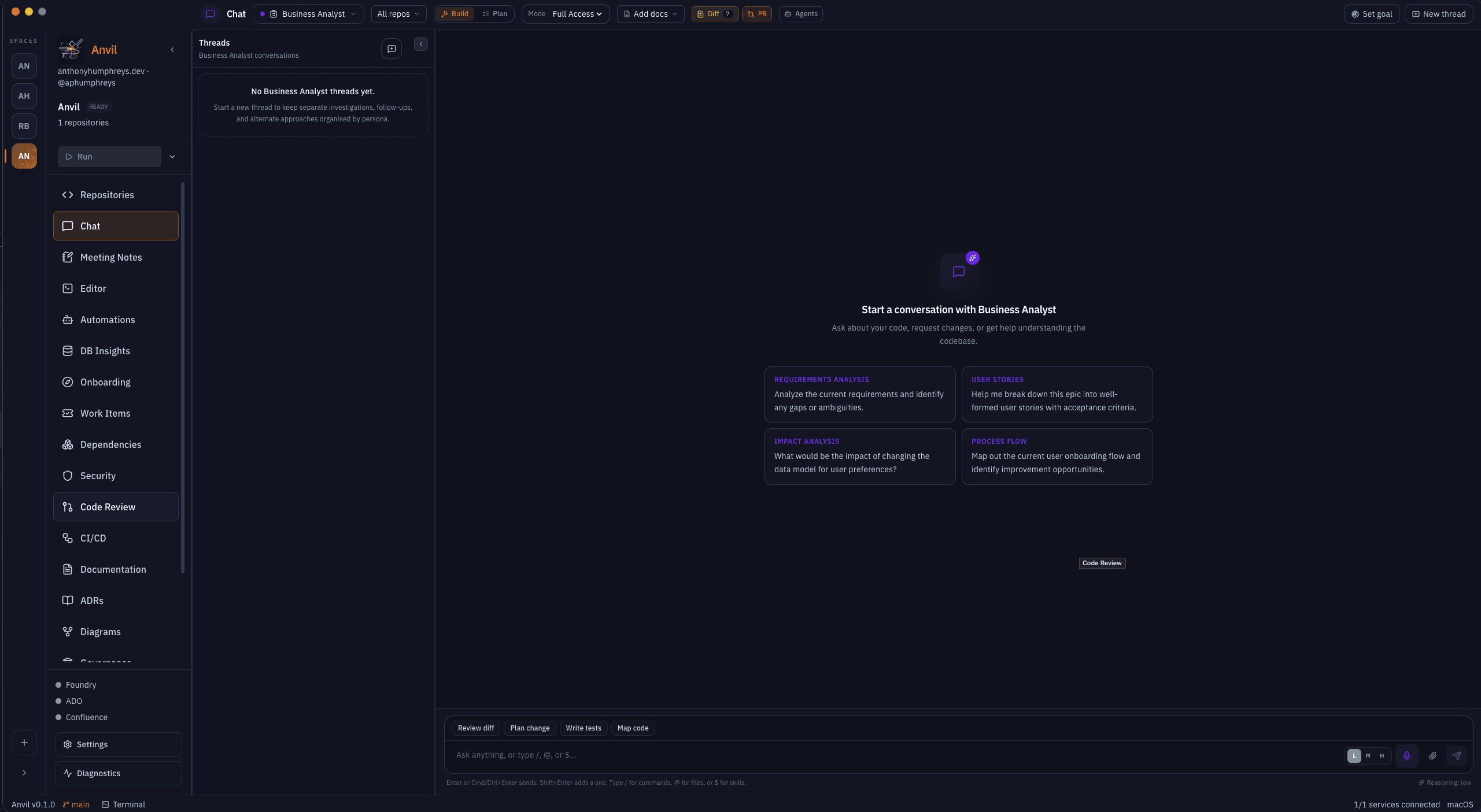
Everything lives in the anvil-stack monorepo, but the split is intentional. Desktop coordinates local work, Registry controls dependency ingress, Node Base constrains install execution, and Cloud constrains app runtime contracts.
anvil-app/
Anvil Desktop
Owns
Local developer workflow orchestration
Start in
src/main, src/preload, src/shared, src/renderer
Use when
A change needs repo context, review evidence, work item context, or local companion controls.
anvil-registry/
Anvil Registry and Node Base
Owns
npm dependency ingress and install execution safety
Start in
apps/gateway, apps/worker, apps/admin, apps/cli, packages, devcontainer-base
Use when
Installs need policy, caching, analysis, quarantine, overrides, reports, or safer container execution.
anvil-registry/devcontainer-base/
Anvil Node Base
Owns
Safer Node dependency installation
Start in
Dockerfile, scripts, README.md
Use when
An unknown repo needs npm installs with lifecycle scripts disabled or observed inside a container.
anvil-cloud/
Anvil Cloud
Owns
Cell runtime contracts and adapter deployment
Start in
packages/runtime, packages/builder, packages/local, packages/client, packages/cli, packages/aws
Use when
A small app or capability-bound agent should be authorable locally, inspectable before deployment, and deployable through an adapter boundary.
The docs explain the mechanics. This is the short operational map.
Local delivery workspace
anvil-app/
A chat-first Electron workspace for repo-aware agent delivery. It keeps conversations, repositories, work items, Git state, reviews, terminals, and handover evidence together while active work continues across workspace switches.
Boundary: Owns local delivery orchestration and evidence capture.
Status: Active desktop app with main, preload, shared IPC, and React renderer surfaces.
Inspectable app runtime
anvil-cloud/
A local-first TypeScript platform for Anvil Cells and contract-first Agents: small runtime units with explicit capabilities, generated manifests, local inspection, approval gates, and adapter-driven deployment.
Boundary: Owns the Cell contract, Agent contract, runtime, auth, builder, local server, Lens, generated client, CLI, and deployment adapter boundary.
Status: Alpha implementation spans runtime, agents, auth, workflows, services, Lens, builder, local, client, CLI, and AWS preview packages.
npm policy gateway
anvil-registry/
A TypeScript registry gateway that proxies npm metadata and tarballs, evaluates deterministic policy, queues package analysis, caches artefacts, and records decisions before installs reach developers or CI.
Boundary: Owns dependency ingress, policy decisions, analysis, cache identity, and override audit.
Status: Alpha for local trials, security review, early CI experiments, and contribution work.
Hardened Node image
anvil-registry/devcontainer-base/
A Node 22 devcontainer base image for safer installs. Safe mode disables lifecycle scripts; observed mode runs them deliberately while writing inspectable reports.
Anvil does not claim that agents, heuristics, or abstractions remove engineering judgement. It gives reviewers better artefacts to judge.
Desktop workflows start from local checkouts, branch state, typed IPC boundaries, SQLite state, Git, PTYs, and explicit connector configuration.
Registry decisions come from deterministic package metadata, static findings, provenance, popularity, overrides, and cached immutable identities.
Cloud Cells and Agents use constrained contracts. Provider SDKs and infrastructure authoring belong in adapters, not app code.
Codex and LLM workflows can plan, implement, review, and explain. The authority still comes from repo evidence, deterministic gates, and human review.
The public site is markdown-first so architecture, setup, limits, and status can be reviewed in Git with the code.
Start with the public docs, then follow the links into commands, architecture, status notes, contribution paths, and the repo boundaries that matter.
Choose Desktop, Registry, Node Base, or Cloud from the project and workflow you actually need.
See which project directory owns which product surface, where to look first, and how the pieces fit together.
Follow the Electron main, preload, shared IPC, renderer, SQLite, and service-layer boundaries.
Run planning, implementation, review, security, documentation, BA, and handover sessions with evidence.
Run the gateway locally, route package manager traffic through it, and inspect package decisions.
Read how metadata, provenance, static findings, popularity, analysis, and overrides shape decisions.
Understand app, schema, query, mutation, endpoint, job, capability, and generated manifest shapes.
Define capability-bound agents, mount them in Cells, compile manifests, and run local stub or provider mode.
Read the contract and AWS Lambda MicroVM provider path for sandbox-required agent workspaces.
Use anvil-cloud new, dev, check, build, inspect, logs, db, and deploy preview with stable JSON output.
Inspect safe and observed install reports, submit them to the registry, and wire them into CI gates.
The scope boundaries, alpha notes, and anti-vendor-sludge position behind the project.
Development setup, commit style, and review expectations across the Anvil monorepo.